If you’ve been pricing out an engineered hardwood floor — the kind that comes as a layered wood plank, more stable than solid hardwood and friendlier to DIY installation — you’ve probably spent a lot of time comparing species, finishes, and wear-layer thickness. That’s all worth your attention. But there’s a layer that sits underneath all of that, one that most buyers spec in about four minutes flat, and it’s responsible for a surprising share of the squeaks, flex, and hollow “clunky” sound complaints that show up in renovation forums six months post-install. That layer is the underlayment — a thin sheet of foam, felt, rubber, or composite material installed directly beneath your flooring. Get it right and it quietly does its job forever. Get it wrong and you’ll feel it on every step.
This guide is for the renovator who’s past the “what’s engineered hardwood?” stage but still building intuition on the underlayment decision specifically. We’ll walk through what actually matters in the spec, how to match underlayment type to your installation scenario, what to skip, and the numbers that should drive your final call.
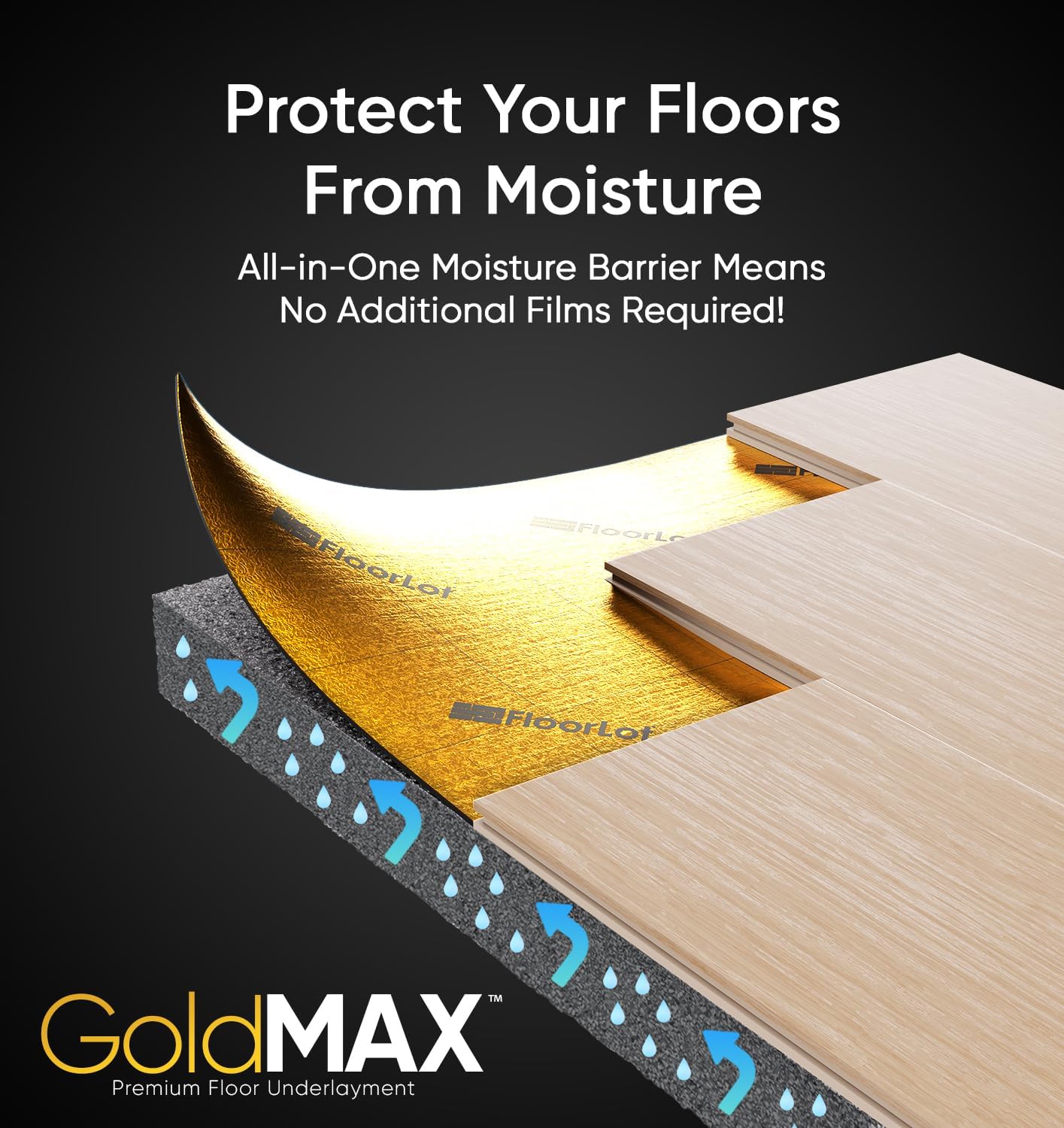
| EDITOR'S PICKFloor Underlayment - Floor Padd… | Mid-tier[Wood Fiber Flooring Underlayment](https://www.amazon.com/dp/B01LD0RC4M?tag=greenflower20-20) | Budget pick[GoldMax Premium Floor Underlaym…](https://www.amazon.com/dp/B07XHC8PL8?tag=greenflower20-20) | |
|---|---|---|---|
| Thickness | — | 6mm | 3mm |
| Coverage | 250 sq ft | 90 sq ft | 200 sq ft |
| Material | — | Wood Fiber | — |
| Moisture Barrier | — | — | ✓ |
| Soundproofing | — | Natural | — |
| Price | $242.00 | $124.99 | $88.99 |
| See on Amazon → | See on Amazon → | See on Amazon → |
Why Underlayment Actually Matters More Than Its Price Tag Suggests
The cost of underlayment typically runs $0.25 to $1.50 per square foot — a rounding error against a $4/sq ft engineered floor. That price gap is part of why it gets underspecced. But the function it serves has outsized consequences for long-term performance.
Underlayment does four things, and understanding them prevents the most common regrets:
1. Moisture buffering. Engineered hardwood is more dimensionally stable than solid wood, but it’s still wood — it will expand and cup if persistent moisture vapor rises from a concrete subfloor. A quality underlayment with a meaningful vapor-retarder rating (expressed in perms, a measure of how much moisture vapor passes through a material per hour) creates a sacrificial buffer between slab and plank. Per the National Wood Flooring Association’s 2024 installation guidelines, floating engineered floors over concrete generally require an underlayment with a perm rating at or below 0.15. Many foam products rated for “all subfloors” don’t meet that spec.
2. Subfloor irregularity compensation. The NWFA and most manufacturer warranties require subfloor flatness within 3/16 of an inch over a 10-foot radius. Most real-world subfloors — especially older slab-on-grade or OSB decks — don’t hit that spec consistently. A slightly compressible underlayment fills minor dips and peaks, reducing hollow spots and plank flex. JLC Online’s piece on floating floor systems is direct about this: underlayment is not a fix for a legitimately out-of-flat subfloor, but it does tolerate the minor variation that’s nearly unavoidable at scale.
3. Sound attenuation. Impact Insulation Class (IIC) and Sound Transmission Class (STC) are the two ratings you’ll see on underlayment spec sheets. IIC measures impact sound (footsteps, dropped objects), STC measures airborne sound (voices, music). In multi-family projects or homes with a finished basement below, these numbers matter and may be required by condo HOA rules. A basic 2mm foam pad might rate IIC 50 / STC 49. A cork-rubber composite might hit IIC 65 / STC 63. That 15-point delta is audible.
4. Thermal comfort. R-value (a measure of thermal resistance — higher means more insulating) affects how warm the floor feels underfoot. Over a cold slab in a basement conversion or a garage addition, R-value matters. Over a wood subfloor above conditioned space, it’s mostly irrelevant.
The Four Underlayment Types, Honestly Compared
Foam (polyethylene or polypropylene)
This is what most big-box flooring bundles include or upsell at the register. It’s cheap, easy to install, compresses cleanly, and handles minor subfloor variation reasonably well.
Where it works: Above-grade installs over wood subfloors where moisture is a non-issue and sound performance isn’t contractually required.
Where it fails: Foam compresses permanently under point loads (chair legs, heavy furniture), which creates hollow “clunky” spots over time. Many foam products lack the moisture-barrier performance needed over concrete — check the published perm rating, not the marketing language. Fine Homebuilding has flagged this repeatedly in floating-floor coverage: “moisture-resistant” on packaging and a 0.15 perm rating on the spec sheet are two different claims.
Typical spec: 2–3mm thickness, R-value around 0.5–1.0, IIC 48–54.
Cork
Cork is a genuinely good material for this application. It compresses under load and recovers, it’s naturally resistant to mold and mildew, and it performs well acoustically. Many premium engineered flooring manufacturers — Lauzon and Mirage among them — list cork as a preferred underlayment in their installation guides.
Where it works: Floating installs where sound performance matters, above or below grade over concrete with a separate poly vapor barrier.
Where it fails: Cork alone isn’t a sufficient vapor barrier — you still need a 6-mil poly sheet (a thick plastic sheet) underneath it over concrete. Some contractors skip this, which is how you get a moldy cork layer in year two. Cost is higher, typically $0.60–$1.20/sq ft.
Typical spec: 3–6mm, R-value 1.5–2.5, IIC 58–65 depending on thickness.
Rubber and cork-rubber composites
The performance tier for sound-critical applications. Rubber underlayments are dense, durable, dimensionally stable, and deliver the highest IIC/STC ratings in standard flooring underlayment. They’re common in multifamily spec work where HOA or building code requires minimum IIC 50 or IIC 60.
Where it works: Below-grade installs over concrete, multi-family or condo projects with acoustic requirements, anywhere long-term durability under load matters.
Where it fails: Cost is real — $1.00–$1.80/sq ft is common. Over wood subfloors in detached single-family homes, you’re often paying for performance you’ll never measure.
Typical spec: 3–8mm, IIC 60–72, often includes an integrated vapor barrier rated at or below 0.15 perms.
Attached (pre-attached to the plank)
Many engineered floors in the $2.50–$4/sq ft range arrive with a thin foam pad already glued to the back of each plank. Manufacturers do this to simplify installation and hit a price point.
This is fine for above-grade installs over wood subfloors. It is a problem over concrete: the pre-attached foam typically doesn’t have the perm rating to serve as a vapor barrier, but it also physically prevents you from adding a separate barrier underneath (the two foam layers create a trapped-air scenario and delamination risk). Per the NWFA’s current guidance, if your floor has attached underlayment and you’re installing over concrete, you should still lay a standalone 6-mil poly vapor barrier beneath it — and check that the total assembly thickness still meets your locking system’s tolerance.
By the Numbers: Underlayment Spec Quick Reference
| Type | Typical Thickness | Approx. Cost/sq ft | IIC Range | Vapor Barrier Built-In? |
|---|---|---|---|---|
| Basic foam | 2–3mm | $0.20–$0.45 | 48–54 | Rarely (check perm rating) |
| Cork | 3–6mm | $0.60–$1.20 | 58–65 | No — add 6-mil poly |
| Rubber/composite | 3–8mm | $1.00–$1.80 | 60–72 | Often yes (verify spec) |
| Pre-attached | 1–2mm | Included | 45–52 | No |
The Installation-Method Variable That Changes Everything
This is where intermediate renovators most commonly miscalculate.
Engineered hardwood installs three ways: floating (planks click-lock together and “float” over the subfloor with no direct attachment), glue-down (full-spread adhesive to concrete or wood), and nail/staple-down (mechanical fastener through a wood subfloor). Underlayment is only relevant in floating installations.
-
Glue-down: The adhesive itself acts as your bond layer, vapor management system, and sound membrane. You don’t use separate underlayment — many flooring adhesives used in glue-down applications have perm ratings and IIC performance specs baked in. Floor Covering Weekly’s 2025 moisture management report notes that one of the most common installation failures in slab-on-grade remodels is contractors adding foam underlayment under a glue-down floor, which prevents proper adhesive bond.
-
Nail/staple-down: The subfloor is wood — you’re over a crawlspace or above grade. Moisture control happens at the subfloor and joist bay level, not at the flooring layer. No separate underlayment required or recommended.
-
Floating: This is where every spec decision above lives. Match the underlayment to your moisture risk, your acoustic requirements, and whether your subfloor is wood or concrete.
The Decision Rule: If X, Then Y
Here’s the framework to cut through the noise:
If you’re installing over a wood subfloor, above grade, in a detached home with no acoustic requirements: A quality 2–3mm foam underlayment is genuinely sufficient. Spend the savings on a better wear layer. Don’t let anyone upsell you into rubber composite in this scenario.
If you’re installing over concrete at any grade level: Verify that your underlayment has a published perm rating at or below 0.15 — not just language about being “moisture-resistant.” Cork with a separate 6-mil poly vapor barrier or an integrated rubber composite with a built-in vapor barrier are both valid choices. Cork with no barrier is not.
If sound performance is contractually required (condo HOA, multifamily): Get the IIC spec in writing for whatever you’re installing and compare it to what’s required. Don’t assume any underlayment marketed as “soundproof” actually meets your building’s minimum. Pull the spec sheet.
If your floor came with pre-attached underlayment and you’re going over concrete: Add the 6-mil poly barrier under the planks. Don’t let the attached foam talk you out of it.
If your subfloor has areas that are more than 3/16 inch out of flat over 10 feet: Fix the subfloor first. No underlayment will compensate for an out-of-spec subfloor — it’ll just flex and eventually crack the locking joints. This Old House’s installation guidance is unambiguous on this point: underlayment is not a leveling compound substitute.
One More Thing Worth Saying
Manufacturer warranty language is the other place this decision lives. Most engineered hardwood warranties — Lauzon, Mirage, and other mid-to-premium brands spec on this explicitly — list approved underlayment types or minimum specifications as a condition of warranty coverage. If you install a $6/sq ft floor on an unapproved $0.20/sq ft foam pad and the planks develop hollow spots or locking-joint failure, that warranty conversation is going to go badly. Pull the installation guide for your specific floor before you buy anything. It takes about three minutes and it’s the most valuable spec research you can do.
The underlayment decision isn’t glamorous, but it’s one of the few choices in a flooring install that directly affects how the floor performs for the entire life of the installation. Match the spec to the scenario, verify the perm rating if you’re over concrete, and let the rest of the renovation budget go toward the floor that people will actually see.